


Cyrqelonex
Vault Archive
Vault Archive
Couldn't load pickup availability
- ⬇️ Digital file available after purchase
- 🗂️ Long-term availability
- 🔒 Secure checkout
- 🗓️ Content updated in 2026
Self-paced learning overview
Problem Statement
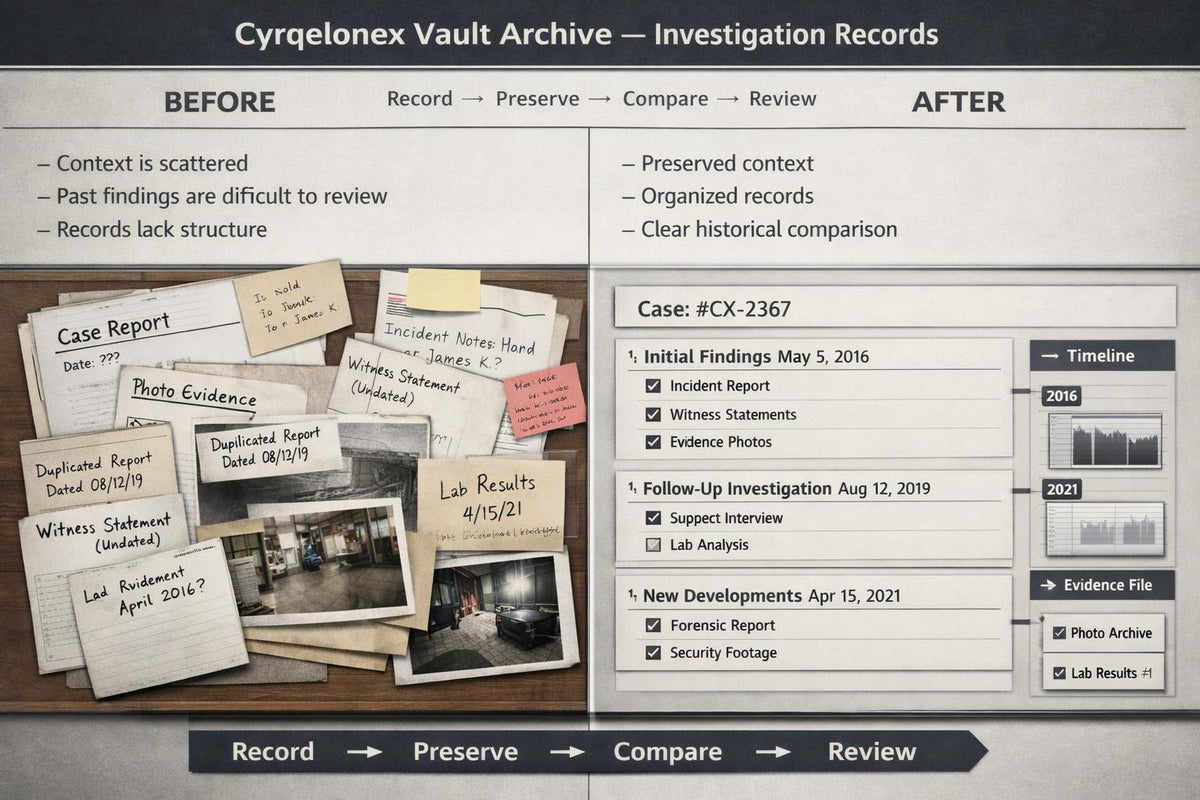
As learners progress into broader malware analysis work, investigations may involve larger collections of observations, artifacts, indicators, and behavioral records gathered across multiple stages. The difficulty is no longer only identifying individual findings, but also preserving context, reviewing earlier evidence, and understanding how older observations relate to newer ones.
The Vault Archive focuses on analytical retention, comparison, and structured review. It helps learners organize investigation material so that important relationships remain clear even as the amount of information grows.
Solution
The Vault Archive introduces a documentation-centered approach to malware analysis.
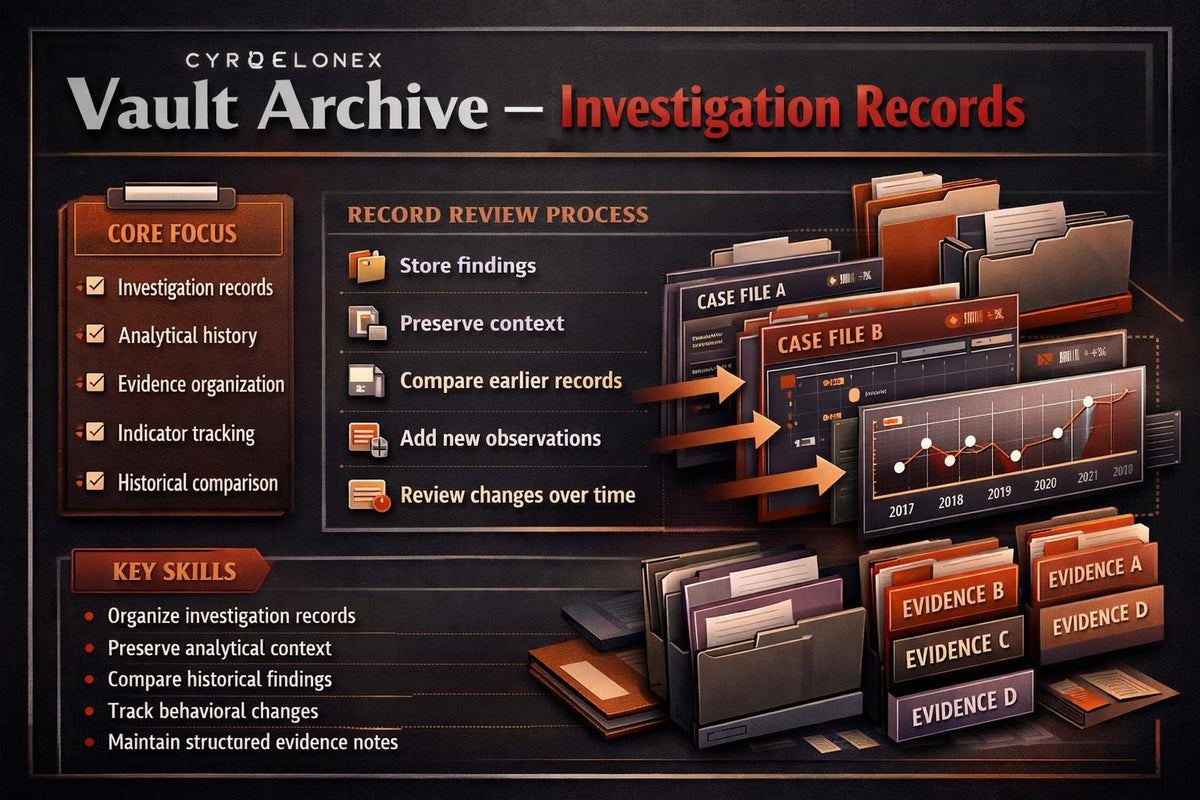
Learners study how to preserve analytical context, organize investigation records, compare earlier and later findings, and revisit stored observations when new information appears.
The course emphasizes careful evidence handling and structured review. Learners explore how to separate confirmed findings, open questions, supporting indicators, and contextual notes so that an investigation remains understandable over time.
This approach helps build stronger analytical habits for work involving multiple layers of evidence.
What’s Inside
The Vault Archive includes detailed lessons on investigation records, evidence organization, analytical history, comparison methods, indicator tracking, behavioral review, and structured documentation.
Learners work through guided examples showing how archived findings can be revisited and compared with new observations.
The course also covers:
- Organizing investigation records by category
- Preserving context around earlier findings
- Comparing historical and current observations
- Tracking changes in behavioral patterns
- Maintaining clear evidence notes
- Reviewing open analytical questions
- Connecting new findings with previous records
- Building structured investigation summaries
Reference materials support consistent terminology and analytical organization throughout the course.
Who Is This For?
The Vault Archive is intended for:
- Learners with an established foundation in malware analysis
- Security students working with larger investigation records
- Learners interested in evidence organization and review
- People who want to improve analytical documentation
- Learners preparing for more detailed multi-stage investigations
Previous familiarity with behavioral analysis, indicators, artifacts, and structured investigation notes is recommended.
What You’ll Learn
- Organize larger sets of investigation records
- Preserve analytical context across different stages
- Compare earlier findings with new observations
- Track changes in behavior over time
- Separate confirmed findings from unresolved questions
- Maintain structured evidence notes
- Review archived observations systematically
- Connect new indicators with previous records
- Build clear analytical summaries
- Improve consistency when revisiting complex investigations
Refund Policy
Eligible purchases of the Vault Archive may be covered by a 30-day refund period, subject to the terms stated in the applicable refund policy.
The refund policy explains the conditions and process for submitting an eligible refund request.
Share
How are Cyrqelonex courses structured?
How are Cyrqelonex courses structured?
Cyrqelonex courses are organized into clear sections that introduce malware analysis concepts step by step. Each tier includes structured materials focused on analytical thinking, investigation methods, malware behavior, and related security concepts. The amount and depth of material increase across the course tiers.
Do I need prior malware analysis knowledge?
Do I need prior malware analysis knowledge?
Not necessarily. The earlier tiers are suitable for learners who are beginning to explore malware analysis, while later tiers introduce broader analytical topics and more detailed study material. Learners can choose a tier that matches their current knowledge and study goals.
What type of materials are included?
What type of materials are included?
Depending on the tier, learners may receive structured lessons, reference materials, analytical examples, study notes, concept explanations, investigation frameworks, and guided activities. Each tier is designed around a defined learning scope rather than a fixed outcome.


Start a Conversation With Cyrqelonex
Have a question about our courses, materials, or learning structure? Send us a message and our team will be glad to assist.
- Choosing a selection results in a full page refresh.
- Opens in a new window.