


Cyrqelonex
Arc Module
Arc Module
Couldn't load pickup availability
- ⬇️ Digital file available after purchase
- 🗂️ Long-term availability
- 🔒 Secure checkout
- 🗓️ Content updated in 2026
Self-paced learning overview
Problem Statement
As malware analysis becomes more detailed, learners need to understand not only what suspicious activity occurs, but also how separate actions form a broader behavioral chain. Individual artifacts, indicators, and events may appear unrelated at first, especially when an investigation contains several stages or multiple forms of activity.
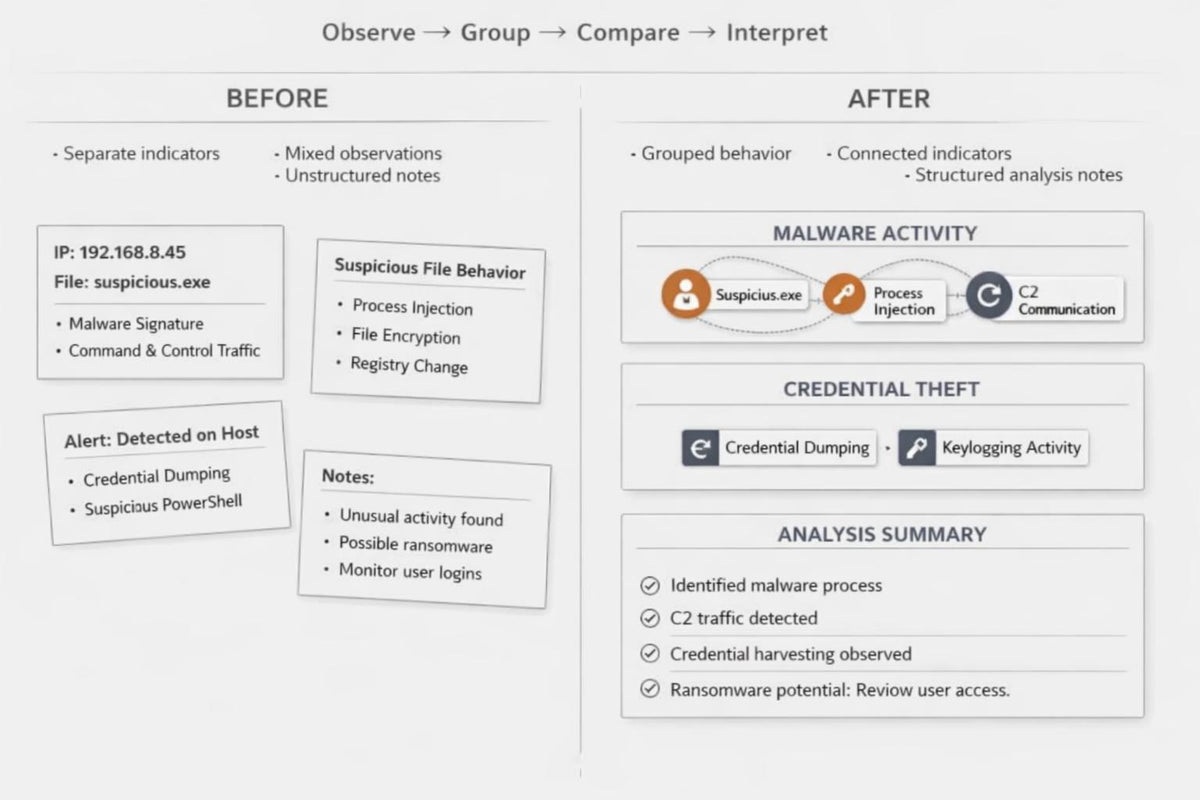
The Arc Module focuses on connecting these separate observations into a more structured analytical view. It helps learners examine how one event may relate to another and how an investigation can be documented as a connected sequence.
Solution
The Arc Module introduces a relationship-focused approach to malware analysis.
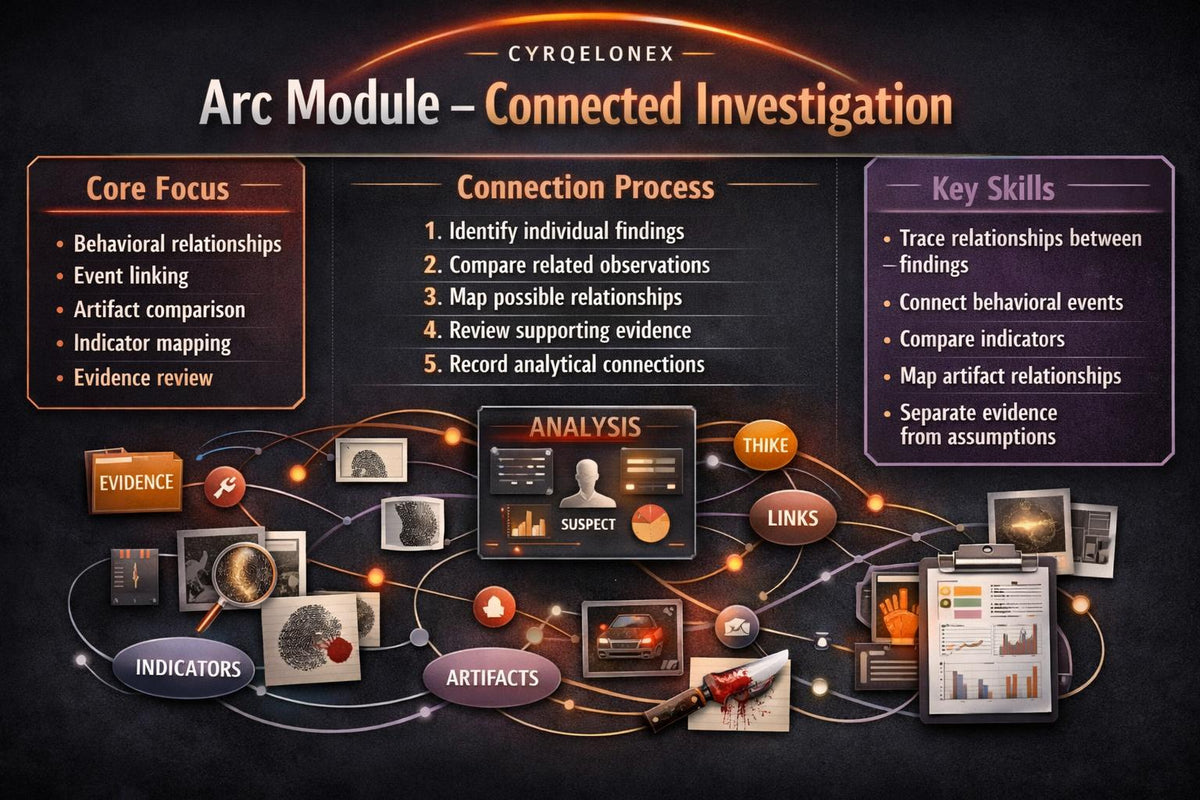
Learners study how to trace connections between behavioral events, artifacts, indicators, and investigation notes. The course emphasizes analytical structure, helping learners understand how separate findings may form a broader sequence without assuming relationships that are not supported by evidence.
The material also develops methods for comparing related observations, documenting analytical links, and reviewing whether a proposed connection is supported by the available information.
This approach helps learners build clearer investigation records and better understand how different parts of an analysis can fit together.
What’s Inside
The Arc Module includes detailed lessons on behavioral relationships, event linking, artifact comparison, indicator mapping, investigation sequences, evidence review, and analytical documentation.
Learners work through guided examples showing how separate observations can be compared and connected within a structured investigation.
The course also includes material on:
- Mapping relationships between findings
- Reviewing sequences of suspicious activity
- Comparing related indicators
- Identifying supporting and conflicting evidence
- Recording analytical links clearly
- Revisiting earlier findings when new information appears
Reference sections help learners organize terminology and analytical concepts throughout the course.
Who Is This For?
The Arc Module is intended for:
- Learners with a developing malware analysis foundation
- Security students interested in relationship-based investigation
- Learners who want to improve evidence organization
- People interested in tracing behavioral connections
- Learners preparing for broader analytical workflows
Familiarity with indicators, behavioral observations, and basic investigation documentation is recommended.
What You’ll Learn
- Trace relationships between investigation findings
- Connect behavioral events into structured sequences
- Compare indicators across different observations
- Map relationships between artifacts and activity
- Identify evidence that supports or challenges an analytical connection
- Document behavioral links clearly
- Review earlier findings when new evidence appears
- Separate observed relationships from assumptions
- Build structured investigation maps
- Improve analytical consistency across complex findings
Refund Policy
Eligible purchases of the Arc Module may be covered by a 30-day refund period, subject to the terms stated in the applicable refund policy.
The refund policy explains the conditions and process for submitting an eligible refund request.
Share
How are Cyrqelonex courses structured?
How are Cyrqelonex courses structured?
Cyrqelonex courses are organized into clear sections that introduce malware analysis concepts step by step. Each tier includes structured materials focused on analytical thinking, investigation methods, malware behavior, and related security concepts. The amount and depth of material increase across the course tiers.
Do I need prior malware analysis knowledge?
Do I need prior malware analysis knowledge?
Not necessarily. The earlier tiers are suitable for learners who are beginning to explore malware analysis, while later tiers introduce broader analytical topics and more detailed study material. Learners can choose a tier that matches their current knowledge and study goals.
What type of materials are included?
What type of materials are included?
Depending on the tier, learners may receive structured lessons, reference materials, analytical examples, study notes, concept explanations, investigation frameworks, and guided activities. Each tier is designed around a defined learning scope rather than a fixed outcome.



Start a Conversation With Cyrqelonex
Have a question about our courses, materials, or learning structure? Send us a message and our team will be glad to assist.
- Choosing a selection results in a full page refresh.
- Opens in a new window.